Perge Ancient City from Side, Turkey
Walk the same marble street St. Paul once crossed, beneath Hellenistic gate towers that have stood for over two thousand years. One of the best-preserved Roman-Pamphylian cities on Turkey’s coast — and an easy half-day trip from Side.

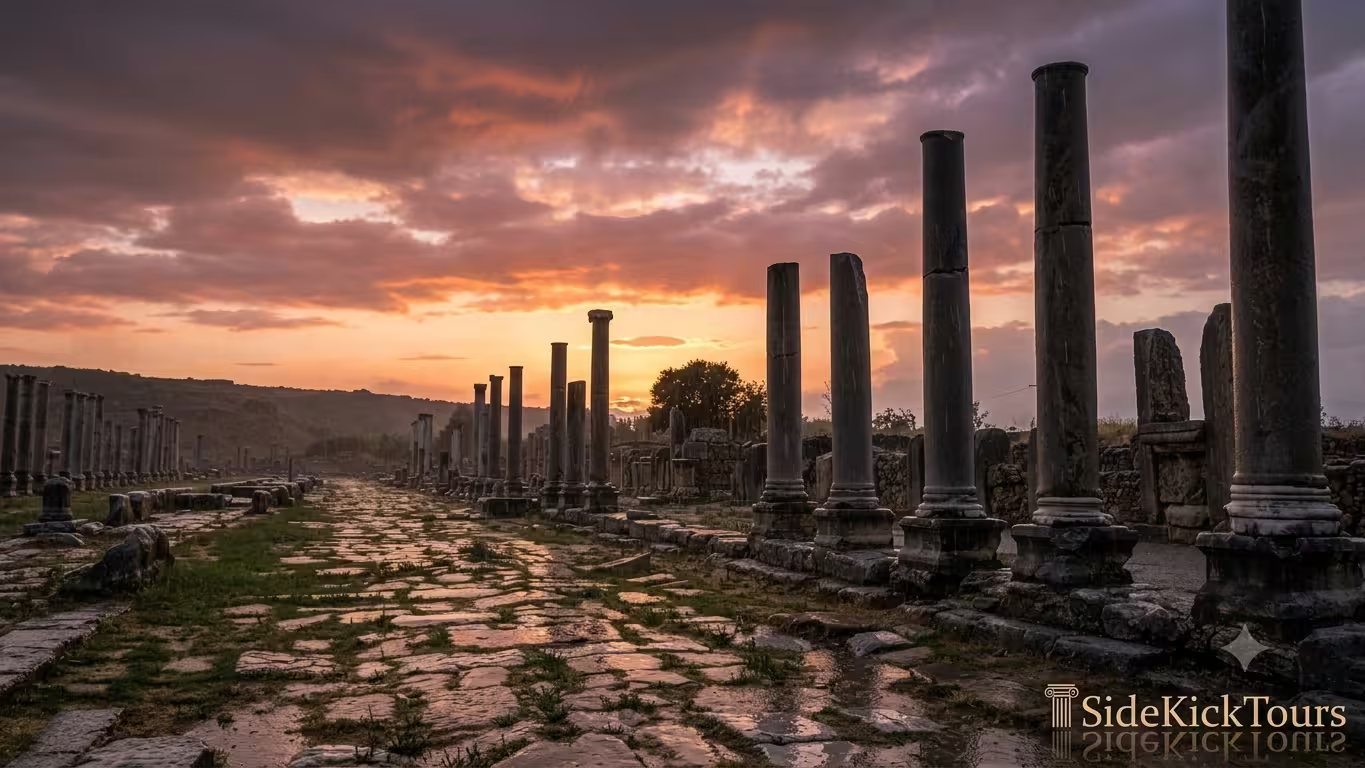
Arrive right at 08:00 opening — the tour buses from Antalya hotels don’t reach Perge until after 10:30, so you’ll have the Hellenistic Gate almost to yourself for photos.
- Distance from Side 60 km ~60–75 min by car
- Visit Time 2–3 hours half-day with Aspendos
- Experience Moderate flat + some uneven ground
- Photography Golden Hour sunrise on the Gate
- Hellenistic City Gate
- Colonnaded Street & Water Channel
- Roman Stadium · 12,000 seats
- South Baths
- St. Paul’s Route
- UNESCO Tentative List
Is Perge Ancient City Worth Visiting?
Highly recommended — for history lovers with half a day to spareYes — with one honest caveat. Perge is arguably the best-preserved ancient city on this stretch of coast: the colonnaded street and its 2,000-year-old water channel, the towering Hellenistic gate, and one of the best-preserved stadiums from antiquity make it feel like a real city, not a scattered ruin. The catch is scale and distance — at 60 km from Side it’s a bigger commitment than Side’s own ruins, and the theatre is currently closed for restoration, so you’re seeing roughly 90% of what makes Perge special, not 100%. For anyone who genuinely likes history, it still earns its place on the itinerary.
Perge vs. Aspendos vs. Side Ancient City
Perge
- Signature: Colonnaded street & Hellenistic gate
- From Side: 60 km · ~60–75 min
- Entry: €11
- Time needed: 2–3 hours
- Right now: Theatre closed for restoration
Aspendos
- Signature: World’s best-preserved Roman theatre
- From Side: ~35 km · ~35–45 min
- Entry: €15
- Time needed: ~1 hour
- Right now: Open — still hosts the opera & ballet festival
Side Ancient City
- Signature: Temple of Apollo at sunset
- From Side: In town · walking distance
- Entry: Temple area free · ruins + museum ~€10
- Time needed: 30–60 min
- Right now: Theatre also closed
Perfect For
- Enjoying a full walk through a real ancient city, not just one photo stop
- Combining it with Aspendos for a full “Pamphylia in a day” history trip
- Seeing St. Paul’s route and Apollonius of Perga’s birthplace in person
- Families with kids 7+ who’ll happily run the stadium track
Consider Skipping If
- You only have one free morning or afternoon and want beach time instead
- Traveling with toddlers, a stroller, or limited mobility — ground is uneven, shade is limited
- You’ve already done Ephesus and want a shorter, lighter history stop — Aspendos is faster
- The closed theatre is the one thing you came specifically to see
The Story of Perge: 4,000 Years in One Ancient City
Perge’s story starts with a legend: heroes sailing home from the fall of Troy, washing ashore on the Pamphylian coast, and founding a city where the Kestros River met the plain. What they actually built has been coming out of the ground one stone at a time since 1946 — and it turned out to be one of the most complete ancient cities on Turkey’s southern coast. Here’s the short version, in order.
- ~1200 BCE
Heroes From Troy
Greek legend credits Perge’s founding to Mopsus and Calchas — seers said to be returning from the fall of Troy — who settled this stretch of Pamphylia. Bronze Age remains on the acropolis suggest people were already living here even earlier.
- Bronze Age
The City of Parha
Centuries before Greek settlers, this same plain shows up in Hittite royal records as “Parha.” A bronze tablet unearthed at Hattusa in 1986 is one of the pieces of evidence historians cite when arguing Parha and Perge are the same city.
- 334 BCE · Hellenistic Age
Alexander the Great — and a Mathematician Is Born
When Alexander’s army reached Pamphylia, Perge surrendered peacefully and reportedly handed over the city’s keys rather than face destruction. Not long after, Perge produced one of antiquity’s greatest minds: Apollonius of Perga, whose work on conic sections still underlies the geometry taught in schools today.
- 1st–3rd Century CE
The Roman Golden Age
Almost everything you’ll actually walk through was built now. The colonnaded street and its water channel, the stadium, the South Baths, the monumental nymphaea — Perge became one of the wealthiest, most sophisticated cities in Roman Pamphylia.
- ~46 CE
St. Paul Passes Through
Paul and Barnabas landed near Perge’s river harbor on their first missionary journey, then returned later to preach in the city itself — one of the New Testament’s concrete links to the exact ground you’ll be standing on.
- 7th Century CE
Decline
Arab raids, earthquakes, and the slow silting of the Kestros River cut Perge off from the sea and from trade. By the Middle Ages, a city that once held tens of thousands had been abandoned to the reeds.
- 1946
Rediscovery
Turkish archaeologist Arif Müfid Mansel began the first systematic excavations at Perge, launching a project that İstanbul University has continued for decades — gradually uncovering the city you can walk through today.
- 2009
UNESCO Tentative ListPresent Day
Following major restoration and anastylosis work, Perge was added to Turkey’s UNESCO World Heritage Tentative List — recognition of a city historians still rank among Anatolia’s best-preserved.
What to See at Perge — In the Right Order
Perge is bigger than it looks from the entrance, and the signposted order isn’t always the most satisfying one. This is the walking order that actually works on the ground — starting near the entrance and finishing at the far end of the colonnaded street.
-
Stadium
One of the best-preserved stadiums anywhere in the ancient world. Its long U-shaped track once held around 12,000 spectators for races and games. Walk the vaulted corridor beneath the seating — you can still make out where shops once opened onto the crowd.
Photo TipShoot from the curved far end looking down the full length of the track — the classic Perge stadium shot.
-
South Baths
A complete Roman bathing sequence survives here: changing room, cold plunge, warm room, and steam-heated hot room, laid out so bathers moved from one to the next. In places you can still see the raised hypocaust floor that once had hot air circulating underneath.
Photo TipGet low and shoot across a hypocaust floor — the rows of brick support pillars make a striking repeating pattern.
-
Hellenistic Gate & Towers
Two horseshoe-shaped towers guard what was once Perge’s main entrance. By 121 CE the Romans had converted the space behind it into a ceremonial courtyard lined with statues of gods and the city’s legendary founders — a direct nod to the myth this guide opened with.
Photo TipStand inside the oval courtyard and shoot back toward the towers — morning light rakes across the stonework beautifully.
-
Colonnaded Street & Water Channel
Perge’s real showstopper: a long marble street lined with columns, with a stone water channel running straight down the middle that once fed a series of cascading pools. It’s the one detail that makes Perge feel like a living city rather than scattered ruins.
Photo TipKneel at one end and shoot straight down the channel — the repeating columns form natural leading lines.
-
Nymphaea (Monumental Fountains)
Perge has two grand fountain façades — dedicated to Septimius Severus and Hadrian — that once fed water into the channel below. Even in ruin, the scale of the multi-tiered stonework hints at how theatrical Roman water displays could get.
Photo TipGo wide-angle from a low crouch — it exaggerates the height of the surviving tiers.
-
Agora
A large open square with entrances on all four sides, once the commercial heart of the city, with shops ringing a central market. A good place to stop and picture the noise and trade of a working Roman city.
Photo TipBest in late afternoon — long shadows from the surrounding walls add depth to an otherwise flat, open space.
-
Theatre Currently Closed
Built in the 2nd century CE for roughly 13,000 spectators, Perge’s theatre is genuinely one of the region’s great Roman structures — but it’s closed to visitors while restoration work is completed. You’ll still see its curved outer wall from the road as you arrive.
Photo TipThe exterior retaining wall, seen from the parking area, still makes a solid establishing shot even while it’s closed.
How to Get to Perge from Side
Perge sits 60 km from Side — about 60–75 minutes by car. There’s no fast public option this direction, so how you travel really does change the day. Here’s how the two realistic choices compare.
Independent
Taxi or rental car — you set the pace
Guided Tour
Hotel pickup, licensed guide, zero logistics
Budget Route: Dolmuş + Tram
- Side/Manavgat dolmuş to Antalya Otogar (bus station) — direct minibus, ~75–90 min
- Transfer to the Antray tram toward Aksu
- From the Aksu tram stop, it’s a ~20-minute walk or a short taxi to the Perge entrance
Our Recommendation
If you’re already renting a car, self-drive and pair Perge with Aspendos in the same morning — it’s the best value by a wide margin. If not, a guided tour genuinely earns its cost here: Perge’s history takes real explaining, and a good guide covering Perge and Aspendos in one day will save you more time than the dolmuş-and-tram route ever could.