🌴 Local tours • Private transfers • Side & Antalya
What are you looking for?
A 2nd-century AD Roman theatre built on unique barrel vaults — one of the largest in Anatolia and a defining landmark of Side Ancient City.
The Side Ancient Theatre is the centrepiece of the Side archaeological site — a massive Roman amphitheatre that once seated thousands, built not against a hillside but on an artificial barrel-vaulted substructure. Today it stands as one of the most impressive surviving monuments of ancient Pamphylia, offering visitors a direct connection to the civic and cultural life of Roman Side.
Location
Side, Antalya, Türkiye — within the Side Ancient City archaeological site
Historical Period
2nd century AD (Roman Imperial period)
Capacity
Approx. 13,000–15,000 spectators — one of the largest in Anatolia
Recommended Visit
30–45 minutes for the theatre; 2–3 hours for the full ancient city
Admission
Paid entry via the Side Ancient City archaeological site ticket — verify current rates before visiting
Opening Hours
Typically 08:00–20:00 in summer; hours vary seasonally — check before your visit
Nearby Attractions
Side Museum, Temple of Apollo, Ancient Harbour, Agora
Note: The theatre interior may be subject to ongoing restoration or preservation work. Interior access can be restricted at times, but the exterior and surrounding archaeological area remain open to visitors.
The Side Ancient Theatre is a Roman amphitheatre built during the 2nd century AD in the ancient city of Side, on the Mediterranean coast of modern-day Turkey. It served as the primary public gathering space for drama, music, civic ceremonies, and political assemblies in Roman Pamphylia — a region where Greek and Roman cultural traditions overlapped.
Unlike many Roman theatres that were carved into natural hillsides, the Side theatre was constructed on level ground using an artificial substructure of barrel vaults. This engineering choice makes it architecturally unusual in Anatolia and allowed the builders to position the structure precisely at the heart of the urban plan, close to the Side Ancient City agora and the main colonnaded street.
The theatre is not merely a ruin — it is a measurable expression of Side’s wealth and civic ambition during the Roman Imperial period. Its scale, estimated at roughly 13,000 to 15,000 seats, ranks it among the largest surviving theatres in the region. The structure also preserves evidence of later adaptation: during the 5th century AD, the stage building was modified for use as an open-air church, reflecting the city’s transition from classical pagan culture to Byzantine Christianity.
Bottom line: The Side Ancient Theatre is the single largest and most visually striking monument within the Side archaeological site. It offers a direct, unfiltered view of how a prosperous Roman provincial city staged public life — from theatrical performances to religious processions — nearly two millennia ago.
The theatre was built during the mid-2nd century AD, a period when Side was flourishing as a major port city in the Roman province of Pamphylia. The structure replaced or substantially expanded an earlier Hellenistic theatre that had served the Greek-speaking settlement. The new Roman design reflected the city’s wealth and its desire to project civic prestige through monumental architecture.
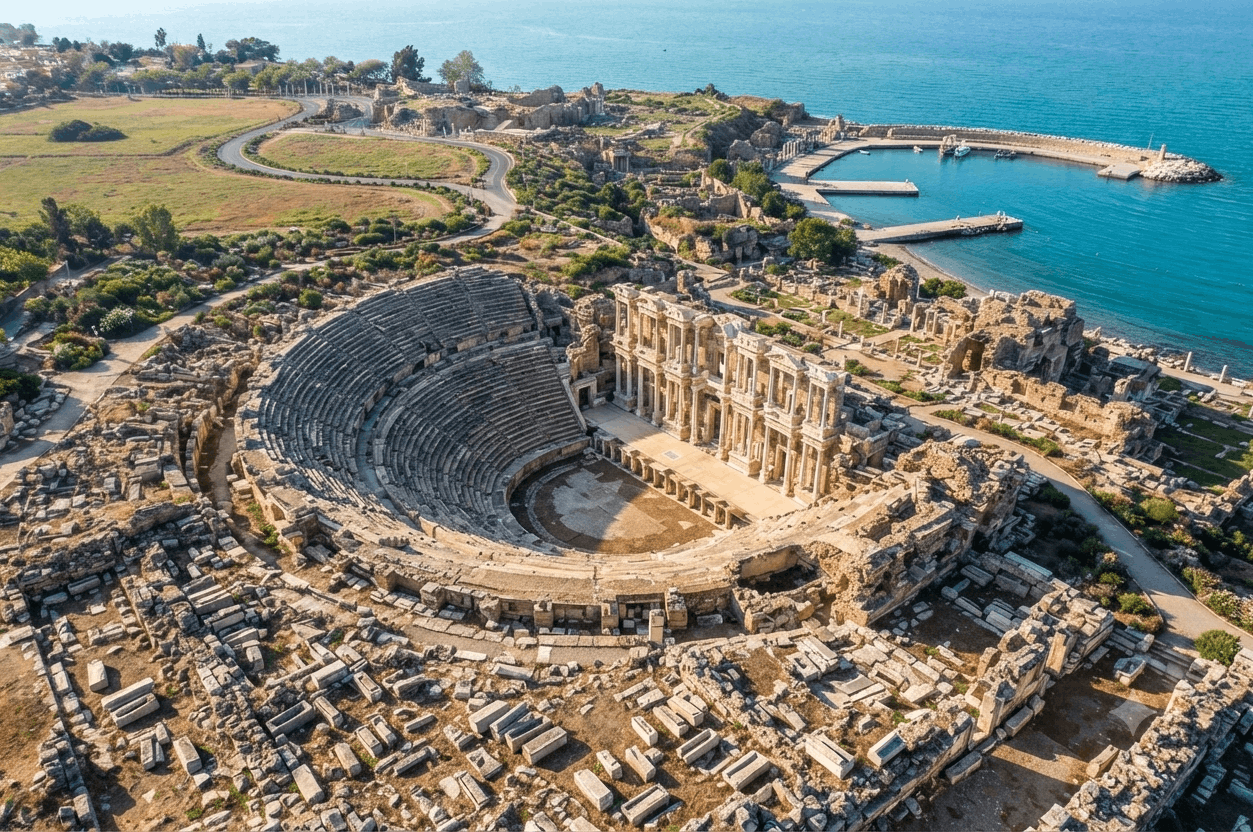
Most ancient theatres were carved into natural hillsides for support. The Side theatre is different: it stands on a massive artificial substructure of barrel vaults built on flat ground. This engineering choice is rare in Anatolia and allowed precise placement at the centre of the urban plan. The vaults created the sloped seating area (cavea) without relying on topography, while also providing enclosed circulation corridors beneath the seating.
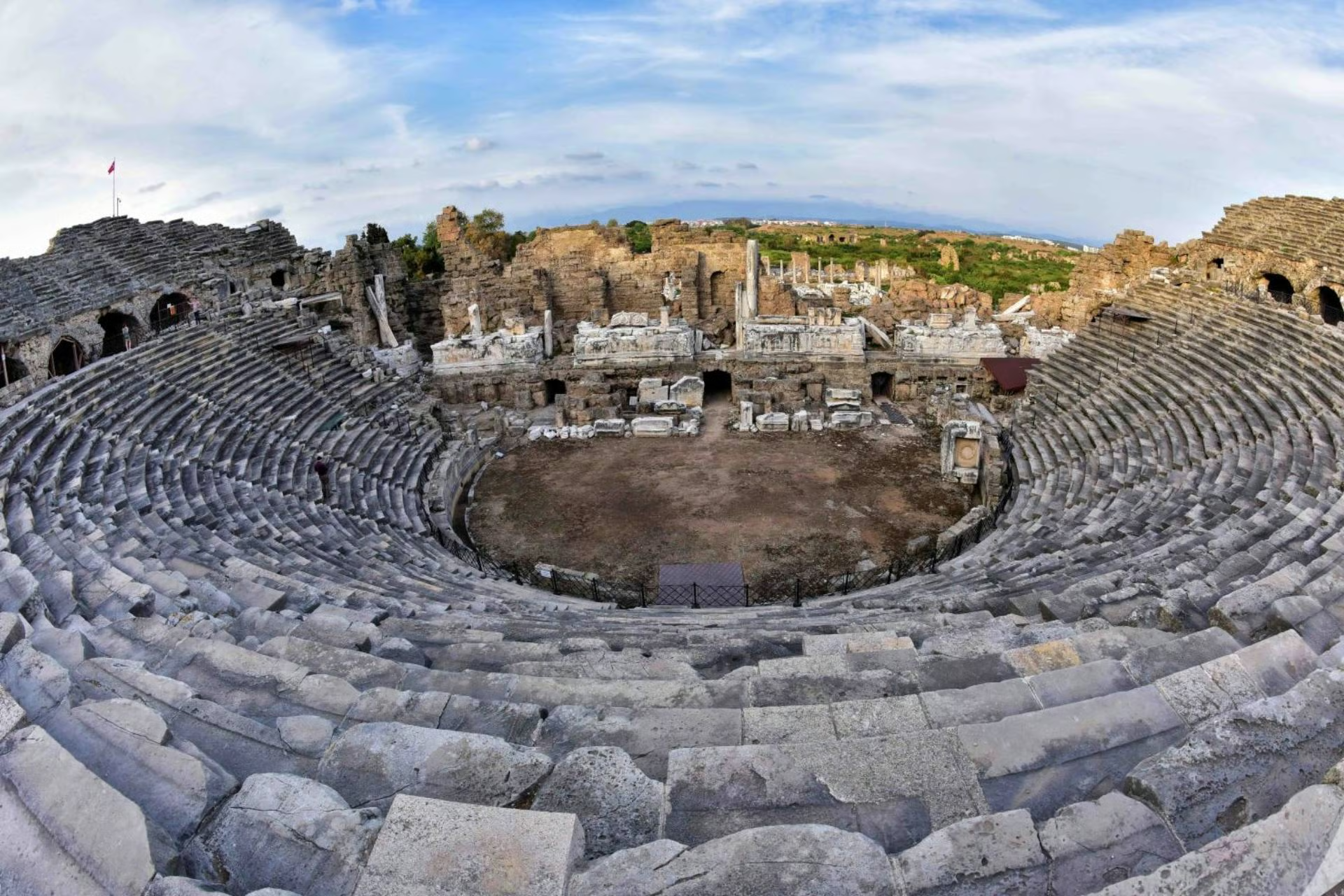
The cavea — the semi-circular seating area — measures roughly 100 metres in diameter and rises approximately 30 metres above ground level. The stage building (skene) extends about 63 metres in length, forming an imposing backdrop to the performance space.
Scholarly estimates place the theatre’s capacity in the range of 13,000 to 15,000 spectators. This scale places it among the largest surviving Roman theatres in the eastern Mediterranean and reflects the substantial population that Side commanded during its peak.
In the 5th century AD, as Side transitioned from pagan Roman culture to Byzantine Christianity, the theatre was repurposed as an open-air church. The stage building was modified to serve liturgical functions, and the structure became a place of Christian worship rather than theatrical performance. This layered history is visible in the architectural modifications that survive in the skene area today.
Key architectural takeaway: The Side Ancient Theatre is defined by two rare features — its barrel-vaulted artificial substructure (unusual for Anatolia) and its documented conversion from a Roman performance venue to a Byzantine church. These layers make it more than a standard Roman ruin: they make it a physical record of cultural transition.
The Side Ancient Theatre has not been fully restored like the theatre at Aspendos. What you see is an archaeological site in a state of partial ruin — and that is precisely what gives it character. The structure retains enough of its original form to convey its scale and function, while the weathered stone and exposed vaulting tell a more honest story of two thousand years of exposure.
The semi-circular rows of seating are still clearly defined, though many stone benches have shifted or collapsed over centuries. If interior access is permitted during your visit, climbing the upper tiers rewards you with a clear sense of the theatre’s scale and a panoramic view across the Side Ancient City toward the Mediterranean. The higher you climb, the more the relationship between the theatre and the urban grid becomes visible.
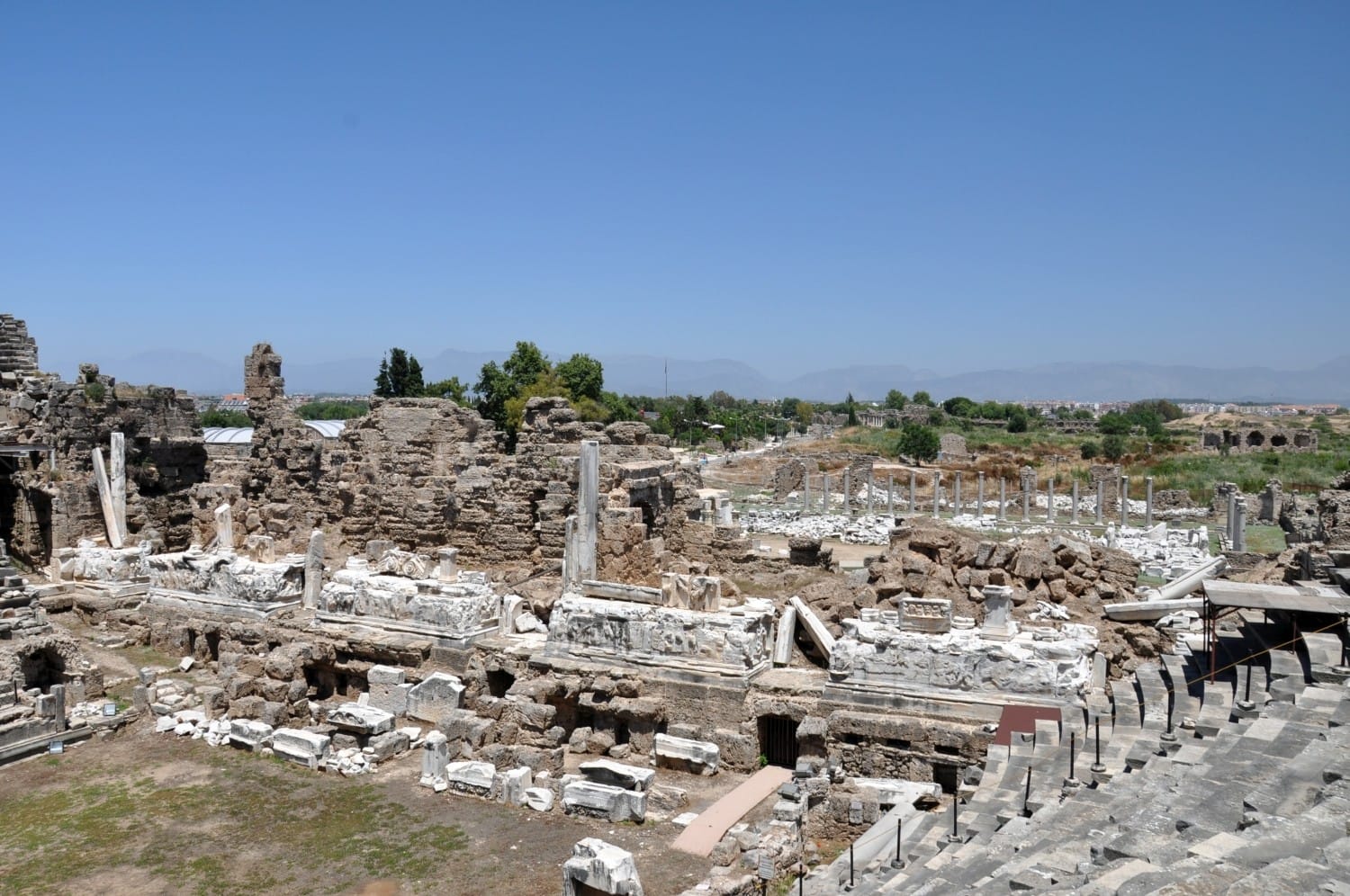
The skene wall survives to a considerable height in places, though much of its original decorative marble facing and architectural sculpture has been lost. What remains is the structural core — a three-storey Roman stage facade that once framed performances and, later, Christian liturgy. Look for the modifications made during the Byzantine period, when the building was adapted for church use.
From the exterior, you can see the network of barrel vaults that support the cavea. These arched corridors are accessible in places and offer a rare glimpse into Roman engineering technique. Walking beneath them provides a tangible understanding of how the builders created a sloped auditorium on flat ground without a natural hillside.
The theatre does not sit in isolation. Immediately nearby are the remains of the agora, the nymphaeum, and the colonnaded street that once connected the civic heart of Side to its harbour. The Side Museum is a short walk away, housed in the former Roman bath complex. The Temple of Apollo and the ancient harbour lie further east along the same pedestrian route.
Many visitors compare Side with the more famous Aspendos Theatre, roughly 40 kilometres east. The difference is straightforward: Aspendos is a meticulously restored performance venue with intact seating, a complete stage, and regular modern concerts. Side is an archaeological ruin in partial collapse.
Choose Aspendos if you want a polished, theatrical experience in a fully reconstructed setting. Choose Side if you prefer to see a Roman theatre as archaeology — weathered, fragmented, and embedded within a wider ancient city rather than standing alone. The two complement each other; they do not replace each other.
The Side Ancient Theatre is not a standalone attraction. It sits at the geographic and civic heart of the Side Ancient City archaeological site, roughly midway between the old city walls and the ancient harbour. Understanding this relationship changes how you visit: the theatre is best experienced as a stop within a broader walking route, not as a destination in isolation.
In the Roman urban plan, the theatre occupied a position of deliberate prominence. It was placed at the intersection of the main colonnaded street and the approach to the agora, making it visible to anyone moving through the civic centre. The structure faces roughly south-east, with the cavea backing onto the higher ground near the city walls and the stage opening toward the lower city and the sea.
This placement meant the theatre functioned as both a performance venue and a processional landmark. Religious festivals, political gatherings, and theatrical events all flowed through this space because it sat at the natural crossroads of movement between the harbour, the market, and the residential quarters.
If you are exploring the full archaeological site, the theatre fits naturally into a west-to-east route:
This route covers roughly 1.5 to 2 kilometres on foot and takes most visitors between two and three hours at a comfortable pace with stops for photography and reading plaques.
The theatre gains meaning when paired with its neighbouring structures:
The theatre is only one chapter of Side’s story. For the full archaeological picture — city walls, harbour, baths, and a complete visitor route — see our Side Ancient City guide.
Read the Full Side Ancient City GuideThe theatre lies inside the Side Ancient City archaeological zone, on the peninsula that forms the historic core of modern Side town. It is roughly 1 kilometre from the main street (Liman Caddesi) that runs through the centre of the resort.
From the town centre, follow the pedestrian signs toward the Side Museum or the ancient harbour. The theatre is visible from several points within the old town and is marked on all local maps. No private vehicle is needed — the entire archaeological area is pedestrianised.
The Side Ancient City site, including the theatre, typically operates on a seasonal schedule. In the peak summer months, the gates are usually open from 08:00 to 20:00. Hours shorten in autumn and winter.
Verify current hours before your visit. Seasonal adjustments, restoration work, or special events can affect access. The archaeological site is an open-air museum, so last entry is usually 30 to 60 minutes before the stated closing time.
Entry to the theatre is covered by the general Side Ancient City archaeological site ticket. There is no separate admission charge for the theatre itself.
Ticket prices change periodically. Check the official museum website or the ticket booth on arrival for the current rate. The Side Museum inside the site may require a separate or combined ticket depending on the season.
30 to 45 minutes is sufficient for the theatre alone — circling the exterior, examining the barrel vaults, and climbing the cavea if access is open. If you are visiting the theatre as part of a broader walk through Side Ancient City, budget 2 to 3 hours for the full route including the museum, agora, and harbour.
The archaeological site is not fully accessible to visitors with limited mobility. The ground is uneven, with loose stone, gravel, and steps throughout. The cavea seating involves steep stone tiers without handrails. The barrel-vault corridors beneath the theatre have uneven floors and low light. Viewing the exterior from the surrounding paths is possible, but full exploration requires sturdy footwear and moderate physical ability.
Early morning (08:00–10:00) and late afternoon (17:00–19:00) offer the best combination of cooler temperatures, softer light, and fewer visitors. Midday in July and August is intensely hot and offers harsh overhead light for photography.
Spring (April–May) and autumn (September–October) are the most comfortable seasons for exploring the entire archaeological site on foot.
The theatre offers strong photographic subjects at every scale:
Tripods are generally permitted for personal photography within the archaeological site, but confirm locally if you are using professional equipment.
Practical summary: Arrive early, wear solid footwear, bring water and sun protection, and plan the theatre as one stop within a 2–3 hour walk through the ancient city. Check opening hours and ticket prices on the day of your visit, as both are subject to seasonal change.
Yes — with the right expectations. The Side Ancient Theatre is worth visiting if you understand what it is and what it is not. It is not a polished, fully restored monument like Aspendos. It is a large-scale Roman ruin embedded within a wider archaeological landscape, and its value lies in authenticity and context rather than spectacle.
Highly recommended. The barrel-vaulted substructure, the scale of the cavea, and the visible Byzantine modifications make this a structurally interesting site. It offers more architectural complexity than many restored theatres because you can see the engineering beneath the surface. If you have already visited Aspendos, Side provides a useful counterpoint — the difference between preservation and archaeology.
Worth including. The theatre is the largest single monument in Side Ancient City and gives an immediate sense of the settlement’s former importance. You do not need deep archaeological knowledge to appreciate the scale. Combine it with the museum and the Temple of Apollo for a complete first impression of ancient Side.
Moderately suitable. Children respond well to the scale and the idea of ancient crowds, but the site is uneven, shadeless, and involves climbing. Young children will need supervision on the stone tiers. If your family is already walking through the old town, the theatre is a natural stop. Do not make a special trip solely for the theatre if your group includes toddlers or mobility limitations.
Prioritise the wider site. If you have only half a day in Side, do not spend it all at the theatre. Walk the colonnaded street, see the Temple of Apollo, and visit the Side Museum. The theatre is a highlight within that route, but it should not displace the broader experience.
Worth the effort. The raw, unrestored state of the theatre produces more atmospheric images than a fully reconstructed venue. The barrel vaults create strong geometric shadows, the weathered stone offers rich texture, and the upper tiers provide a panoramic frame over the ancient city. Golden hour is the best window — the warm Mediterranean light against the limestone is hard to replicate elsewhere.
The honest verdict: Side Ancient Theatre is worth visiting if you are already exploring the archaeological site and you value authenticity over polish. It will not impress visitors looking for a fully restored ancient monument. It will impress visitors who want to see how a Roman provincial theatre actually survives — fragmented, weathered, and embedded in the landscape of a city that outlived its empire.
See All Things to Do in SideHave a question that is not answered here? Check our Side Ancient City guide for more detailed visitor information.